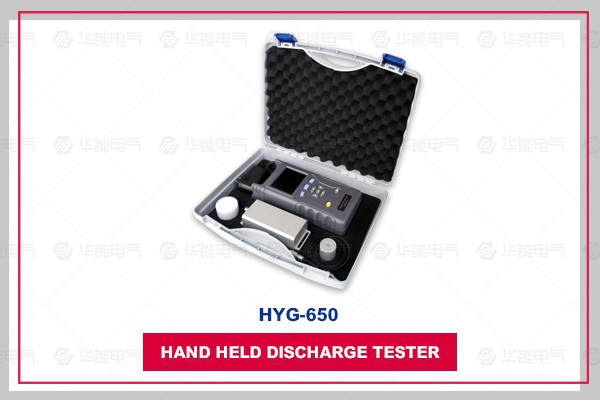
This instrument is used to detect local power sources in medium-high voltage(MV/HV) equipment.
Regarding product purchases, technical maintenance, and other services, please feel free to call:400-8828-058
An electrical discharge that does not completely short-circuit the electrode. The amplitude of this discharge is usually small. However, they do lead to a continuous decline in the performance of the insulation layer, eventually leading to the failure of electrical equipment.
Non-intrusive partial discharge detection provides a fast and simple method for identifying potential insulation failures that may cause power outages or human injury.
Local discharges emit energy in the following ways:
Electromagnetic energy: radio waves, light, heat
Sound energy: sound waves, ultrasound
Gases: ozone, nitrogen oxides.
The most practical technology for non-intrusive detection is based on the detection of high-frequency parts of the electromagnetic spectrum and ultrasonic signals. This product is designed to detect electromagnetic and ultrasonic activities of the instrument.
1, the scope of application: the use of non-intrusive detection methods, high voltage electrical equipment to detect and locate the partial discharge defects.
2, sensor configuration
Standard: Ultrasonic Sensor(UA), Ground Wave Sensor(TEV)
Selected: Transformer special sensor network, GIS special ultra-high frequency sensor, high voltage cable special sensor, can also be customized according to user requirements.
2, the principle of detection: ultrasonic(UA), Earth wave(TEV) and ultra-high frequency(UHF).
3, detection frequency band:
Ultrasonic: 40 to 200 KHz
Ground Wave: 3 ~ 100 MHz
UHF: 300 ~ 2000 MHz
4, measurement range:
Ultrasonic: -90 ~ 80dB
Ground wave: -80 ~ 10dBm
UHF: -80 ~ 10dBm
5, sensitivity: minimum 10pC(depending on the distance between the sensor and the power supply).
Sensor:
1 Ultrasonic sensor: 20 to 200(kHz);
2 Earth Wave(TEV): 5 ~ 100MHz.
3 UHF sensor: 300 ~ 2000(MHz), with directional reception characteristics;
7, has a built-in ultrasonic sensor, ground wave, ultrasonic two-in-one sensor, optional Transformer special sensor, GIS special sensor, cable special sensor and other components;
8, software features:
1 Continuous detection of ultra-high frequency, ground electricity and ultrasonic signals to determine whether there is a partial discharge;
The change trend of the measured signal can be displayed in real time, and the development of the partial discharge signal can be judged intuitively.
3 It has the function of field storage of data.
9, instrument characteristics:
1 Screen display: high contrast 3.5 inch TFT color screen.
2 Data storage: 1000 test data can be saved.
3 Working power supply: built-in 8.4 V lithium battery, can work continuously for 8 hours.
4 Power supply: input 100-240VAC, output 8.4 V/3A, charging time 3-4 hours.
5 Dimensions: 230 × 120 × 55(mm).
Weight of instrument: 0.7 kg.
7 Use temperature: -25 °C ~ 45 °C.
The keyboard layout of this product is as follows:
1) F1 key: Press the "F1" key during the test to store the current measurement data;
2) F2 bond: historical data in the host memory can be pulled out by the "F2" key;
3) F3 bond: When measuring the interface, the F3 key is used to switch the sensor type, and the exit key is in the data management or setting interface;
4) Direction keys: The upper and lower direction keys are used to adjust the gain during testing and can be adjusted between 0 and 90 dB; Used to adjust time, etc. in function settings; Used for up and down pages in historical data browsing;
Figure II Keyboard Layout
5) Confirmation key: Press the confirmation key in the test to enter the setting menu;
6) Power supply: the power supply of the instrument is turned on and off. It takes 3 seconds to take effect;
In addition to a built-in ultrasonic sensor, the host of this product is also equipped with an external sensor interface. The TEV sensor and the external ultrasonic sensor are all connected through this interface and are designed using the same interface to make the operation easier.
Note: The external sensor interface uses an imported connector. When inserting the external sensor connector, please insert the logo direction of the connector in the same direction as the logo direction of the socket. After hearing the "click wipe" sound, the connection is successful. Do not rotate the connector. To avoid damaging the connector. When pulling out the sensor connector, only the connector with the metal shell should be pulled out. Do not pull the cable.



武汉华能阳光销售经理

